List of GM engines
GM Diesel Engines In the face of the 1970s 'gas
crisis', GM turned to Diesel power for economic benefit, directing
the Oldsmobile division to develop a V6 and two V8 engines, to
be shared with all divisions.
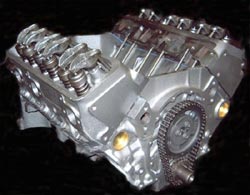
These Diesel engines were designed to fit into the engine bays
of gasoline powered automobiles, but despite popular belief, they
were not "converted" gasoline engines. Oldsmobile's diesel engines,
the 5.7 L LF9 and 4.3 L LF7 V8s and 4.3 L LT6/LT7/LS2 V6, were
notoriously unreliable, particularly in the earliest versions,
though reliability had improved by the early 1980s with the advent
of the DX block, along with better fuel filtering and water separators.
By the early 80's,the 5.7L diesel was a fairly reliable engine
with the introduction of the rollerized camshaft/roller lifter
combination and had many improved enhancements that the late 70's
5.7L diesel engines did not have.
In the 1980s and 1990s GM produced the 6.2 L and 6.5 liter V8
Diesels for use in light trucks and in the Hummvee or Hummer.
Today, GM uses Diesel engines from a joint corporation between
GM and Isuzu Dmax (for trucks) but offers no domestic Diesel passenger
cars. General Motors' Opel division is one of the leading proponents
of Diesel cars in Europe, however. In the 1970s, Opel developed
the first Opel Diesel engine ever. This 2.1- litre engine made
some records in a car specially built for this purpose, the Opel
Rekord D (2100 cc, 60 hp). Later versions were used in the Rekord
E and the Ascona B. Vehicles using these engines could be identified
by a little "hill" in their hoods. Without this "hill" in the
hood, the space for the engine would have been too small. Kadett
D, E and Ascona B and C models also used an Opel engine (1600
cc, 54 hp). Later Isuzu engines were installed, namely for the
Corsa A (1500 cc, 50 hp (37 kW) and 1500, turbo, 67 hp) as well
as for the Kadett E and Vectra A (Vectra A TD: 82 hp).
Opel today uses common rail direct injection engines designed
and produced by Fiat S.p.A (MultiJet) and Isuzu (Circle L). Ownership
of both designs was acquired by GM in 2005, and a new GM Powertrain
Europe division in Turin, Italy (home of Fiat) was founded to
manage these assets. The Fiat Diesel engine has 1900 cc, but before
this cooperation, Opel had already developed two of their own
engines, namely 2- litre Diesels with 82 and 100 hp (70 kW); which
were installed mostly in the Vectra B. GM Daewoo recently licensed
two common rail designs from VM Motori.
Many of the failures and complaints GM endured have shaped the
design of Diesel engines today to be quite reliable and good performing
engines. Today's Diesels have excellent fuel filtration systems
to minimize failures of injection systems. Many manufacturers
require owners to use specific types of oils in their diesel engines,
and the use of these oils must be proven for warranty claims (Volkswagen
TDI). Drivers also complained of the lack of power, unpleasant
noise, and the dirty, smelly exhaust from early GM diesels. Today's
diesels with common-rail injection tackle all these shortcomings.
They are extremely efficient, yet provide significantly more power
than older diesels, and they do so with significantly less pollution
and noise. Today's dealer mechanics have also undergone the proper
training to service the engines properly.
GM Straight-3 Engines
- 1985-1986 GM/Suzuki LY9
- 1996 Ecotec Family 0 - 1.0 L DOHC
Non-GM engines:
- 1990s S-TEC - 0.8 L SOHC
GM Straight-4 Engines
- 1913-1928 Chevrolet 171
- 1937-1965 Opel Olympia engine
- 1962-1984 Chevrolet 153 - 153 cubic inch/2.5 L from the Chevy
II
- 1961-1963 Pontiac 195 - pushrod I4
- 1962-1993 Opel OHV - pushrod I4
- 1971-1977 2300 - SOHC I4
- 1977-1993 Iron Duke - 151 cubic inch/2.5 L pushrod I4, AKA
Tech IV/Crossflow/2500/Pontiac 2.5
- 1980s OHV - 1.8/2.0/2.2 L OHV I4
- Family II - OHC engines for compact cars
- 1979 - 1.4/1.6 L SOHC made by Opel
- 1990s - 1.6/1.8/2.0 L DOHC
- 1980s - 1.8/2.0 L SOHC made by Holden
- 1990s D-TEC - 2.0 L DOHC
- 2003 E-TEC II - 1.8 L DOHC
- 1990s Brazilian - 1.8/2.0 L
- 1988-1995 Quad-4 - 2.3 L DOHC I4
- 1996-2001 Twin Cam - 2.4 L DOHC I4
- Family 1 - OHC engines for compact cars
- 1993 - 1.4/1.6/1.8 L SOHC made by Opel
- 1990s - 1.8 L DOHC
- 2001 Ecotec TwinPort 1.4/1.6 L DOHC
- 2005 Ecotec DCVCP - 1.8 L VVT
- 1990s D-TEC - 1.3/1.5/1.6 L
- 2000s E-TEC II - 1.4/1.5/1.6 L
- 2002 L91 - 1.6 L DOHC
- 1990s Brazilian - 1.0/1.4/1.6/1.8 L SOHC
- 1990-2000 Saturn L24/LL0 - 1.9 L SOHC/DOHC
- 1996 Family 0 Ecotec - 1.2 L DOHC engine for Opel/Vauxhall
cars
- Family II Ecotec - 2.0/2.2/2.4 L DOHC engines
- 2003 Turbo - 2.0 L turbocharged (Opel)
- 2001 L61 - 2.2 L
- 2005 DI - 2.2 L Direct injection (Opel)
- 2000s L42 - 2.2 L CNG
- 2004 LSJ - 2.0 L supercharged for Saturn ION Red Line
and Chevrolet Cobalt SS.
- 2005 LE5 - 2.4 L VVT
- Vortec - longitudinal I4 for trucks
- 2000s L43/LN2 2200 - 2.2 L
- Atlas - longitudinal I4 for trucks
- 2004-2006 LK5 Vortec 2800 - 2.8 L
- 2007-present LLV Vortec 2900 - 2.9 L
Non-GM engines:
- 1960-1973 Triumph/Saab Slant-4 - 1.7/1.85/2.0/2.3 L Saab
engine
- 1973-1981 Saab B engine
- 1981-present Saab H engine
- Late 1980s to early 1990s 4A-GE 1.6 L Toyota I4 for
the Chevrolet Nova and Geo Prizm GSi
- 2000s LV6/LNK - 1.8 L Toyota I4 for the Pontiac Vibe
- 2000 Circle L - 1.7 L diesel designed by Isuzu (branded
as Ecotec DTi)
- 2000 JTD/MultiJet - 1.3 L and 1.9 L common raildiesels
designed by Fiat (also branded as Ecotec CDTi)
- 2002 S-TEC - 1.0/1.2 L SOHC designed by Daewoo Motors
- 2006 VCDi - 1.5 L and 2.0 L common rail diesels produced
by GM Daewoo (designed by VM Motori) (also branded as Ecotec CDTi)
GM Straight-5 Engines
- Atlas - longitudinal I5 for trucks
- 2004-2006 L52 Vortec 3500 - 3.5 L
- 2007-present LLR Vortec 3700 - 3.7 L
GM Straight-6 Engines
GM has produced a few families of straight-6 engines. The first
was introduced 1929 to replace the straight-4 previously used
in Chevrolet cars. It lasted until the 1970s in GM cars, and all
the way until 1988 in Chevrolet and GMC trucks/vans. A new straight-6
was introduced in 2002 as part of GM's Atlas truck engine program.
- 1929-1936 Chevrolet Generation 1 - 181/194/207 cubic inch
- 1935-1936 Pontiac 208 - 208 cubic inch
- 1936-1966 Opel Kapitän engine - 2.5L, 2.6L
- 1937-1950 Oldsmobile/GMC - 215/230/238/257 cubic inch
- 1937-1962 Chevrolet Generation 2 - 216/235/261 cubic inch
- 1937-1954 Pontiac/GMC - 222/223/239 cubic inch
- 1939-1953 GMC - 228/236/248/256/270 cubic inch
- 1962-1984 Chevrolet Generation 3/Post-Stovebolt/L22 -
194/230/250/292 cubic inch
- 1964-1965 Pontiac 215 - 215 cubic inch
- 1966-1969 Pontiac OHC-6 - 230/250 cu in (used in Tempest/Firebird,
low comp single barrel carb or 'sprint' version high comp 4 barrel
carb)
- 1968-1993 Opel - 2.5, 3.0, 3.6 L
- 2002- Atlas LL8 Vortec 4200 - 4.2 L
Non-GM:
- 1999- Daewoo XK6 used in the Daewoo Magnus/Daewoo Tosca
Holden in Australia also used straight-6 engines for a number
of years in their family sedan models, with local engines ranging
in size from 2.15L (132ci) in the original Holden 48-215 of 1948,
to the 3.3L (202ci) six used in the 1970's and 80's, up until
1985 with the VK Commodore model. These engines were colour coded
and often referred to by the colour of their engine block (grey,
red, blue, black). This was replaced in the 1986 VL Commodore
model to coincide with unleaded fuel being required in Australia.
Since the old engine was considered unsuitable, and a new engine
hadn't been developed, the VL Commodore sported the 3.0L Nissan
RB30 engine, the last straight six used in a Commodore.
GM Flat-6 Engines
General Motors produced just one flat-6 engine (sometimes called
the "pancake 6"), the 1960s Chevrolet Corvair engine.
GM V6 Engines
General Motors was the pioneer of the V6 engine in the United
States. At that same time, the company began designing a 60degree
V6 for their new compact cars. This line started slowly, powering
only the smallest cars. One notable version was the DOHC LQ1,
designed with Lotus. The smooth and compact 60degree engine has
become GM's platform of the future, spawning the new global High
Value family.
Other V6es came and went in recent decades, including the V8-derived
Olds Diesel 4.3 and Vortec 4300 and Premium V-based LX5. The European
Opel/Cadillac/Saturn 54degree V6 has spawned the company's other
future V6, the global High Feature DOHC engine.
90degree Buick V6 family - 90degree pushrod V6
Series I:
- 1962 198 - 198 cubic inch (3.2 L) Buick
- 1963-1971 225 - 225 cubic inch (3.7 L) Buick/Jeep
- 1975-1977 231 - 231 cubic inch (3.8 L)
- 1978-1979 3.2 - 196 cubic inch (3.2 L)
- 1978-1988 3.8 - 3.8 L
- 1980-1984 4.1 - 4.1 L
- 1988-1994 3800 - 3.8 L
- 1989-1993 3300 - 3.3 L
Series II:
- 1995-2005 L36 3800 - 3.8 L
- 1996-2005 L67 3800 SC - 3.8 L supercharged Series
III:
- 2004-present L26 3800 - 3.8 L
- 2004-present L32 3800 SC - 3.8 L supercharged
- 60degree V6 family - Pushrod V6
- 1985-1988 L44 - 2.8 L OHV
- 1989-1994 LH0 - 3.1 L OHV
- 1993-1995 L32 - 3.4 L OHV
- 1991-1997 LQ1 - 3.4 L DOHC
- 1996-2004 LA1 - 3.4 L OHV
- 2000s LB8 - 2.5 L (China)
- 2000s LW9 - 3.0 L (China)
- 2000s LG8 - 3.1 L
- 1980s Olds Diesel 4.3 - 90degree 4.3 L Oldsmobile Diesel
- 1985-present Vortec 4300 - 90degree 4.3 L V6 developed
from the Chevrolet 350 cubic inch V8
- 1985-2002 L35/LF6 - 4.3 L central-port injected
- 1985-1998 LB4 - 4.3 L TBI
- 2002-present LU3/LG3 - 4.3 L Multi-port injected
- Opel/Cadillac/Saturn 54degree DOHC V6
- 1994-2005 L81 3000 - 3.0 L
- 2003-2004 LA3 - 3.2 L
- 1990s LX5 - 90degree 3.5 L DOHC Oldsmobile V6 based on
the Premium V
High Value 60degree V6 family - Descended from the 60degree
V6
- LX9 3500 - 3.5 L
- LZ8 3900 - 3.9 L
- High Feature - DOHC V6
- 2004 LY7 3600 - 3.6 L
- 2005 LP1 2800 - 2.8 L
Non-GM engines:
- 2000s LE8 - 2.5 L V6 for the Chevrolet Tracker
- 2000s L66 - 3.5 L DOHC V6 from Honda
- DMAX V6 - 3.0 L Diesel V6 designed by Isuzu
GM Straight-8 Engines
- 1934-1936 LaSalle
- 1934-1953 Buick Series 40-90 (233/248/263/320)
- 1937-1949 Oldsmobile 257
- 1940s GM Straight-8 engine
- 1933-1954 Pontiac Straight-8 engine
GM V8 Engines
Chevrolet had two different V8s, the big-block and small-block.
Today, there are only three V8 engines produced by GM: the Generation
IV small-block and big-block, and Cadillac's advanced DOHC V8,
the Northstar.
- 1914-1992 Cadillac V8
- 1914 Type 51 314 cubic inch (5.1 L)
- 1928 341/346/322 341 cubic inch (5.6 L), 346 cubic inch
(5.7 L), 322 cubic inch (5.3 L)
- 1949 331 331 cubic inch (5.4 L), 365 cubic inch (6.0
L), 390 cubic inch (6.4 L)
- 1963 429 429 cubic inch (7.0 L), 472 cubic inch (7.7
L), 500 cubic inch (8.2 L)
- 1977 L33/L35/L61/L62 425 cubic inch (7.0 L), 368 cubic
inch (6.0 L) V8-6-4
- 1982 LC7/LT8/LQ6/LR6/LW2/L26 4.1 L, 4.5 L, 4.9 L
- 1949-1990 Oldsmobile Rocket V8
- 1949-1964 Generation 1 (303/324/371/394/215)
- 1964-1990 Generation 2 (330/400/425/455/350/403/260/307)
- 1953-1980 Buick V8
- 1953-1959 Buick (264/322)
- 1957-1966 Nailhead (364/400/401/425)
- 1961-1980 Buick "Small-Block" (215/300/340/350)
- 1967-1976 Buick "Big-Block" (400/430/455)
- 1954-1980 Pontiac V8
- 1955-1958 Pontiac/GMC V8 (287/288/316/336/347/370)
- 1959-1980 Pontiac V8 (326/350/389/400/421/428/455)
- 1977-1981 Pontiac "Low Deck" (265/301)
- 1958-1983 GMC
- 1958-1959 GMC 336 336 cubic inch (5.5 L) 90degree
- 1960s GMC 637 637 cubic inch (10.4 L) 60degree
- 1969-1983 GMC 366 366 cubic inch (6.0 L) 90degree
- 1961-1964 Buick/Oldsmobile/Pontiac 215 aluminum V8 (now
Rover V8 engine)
- 1954-1968 Chevrolet small-block V8
- 1954-1956 265 cubic inch Corvette V8
- 1957-1962 283 cubic inch Corvette V8
- 1967-1969 302 cubic inch Camaro Z28
- 1963-1968 327 cubic inch Corvette V8
- 1975-1976 4.3 L Monza V8
- 1976-1979 5.0 L Monza V8
- 1969-2005 Chevrolet Small-Block 350
- 1969-1975 ZQ3
- 1969-1972 L46 - High-compression
- 1970-1972 LT-1 - High-performance
- 1971-1979 L48
- 1973-1980 L82 - Modified 350
- 1974-1981 LM1 - 350
- 1980-1987 LG4 - California L48
- 1981 L81
- 1982-1984 L83
- 1985-1996 L05
- 1985-1991 L98
- 1996-2005 L31
- 1958-present Chevrolet Big-Block engine
- 1958-1965 Generation 1 (348/409)
- 1965-1996 Generation 2 (396/402/427/454)
- 1996-2001 L19 Vortec 7400 - 7.4 L V8
- 2001-present L18 Vortec 8100 - 8.1 L V8
GM later standardized on the later generations of the Chevrolet
V8 design:
- 1990-1994 LT5 - Corvette ZR-1 V8
1992-1997 Generation 2 small-block pushrod V8 family:
- 1992-1997 LT1 - 5.7 L V8
- 1996-1997 LT4 - High-output LT1
- 1994-1996 L99 - 4.3 L V8
1998-present Generation 3 small-block pushrod V8 family:
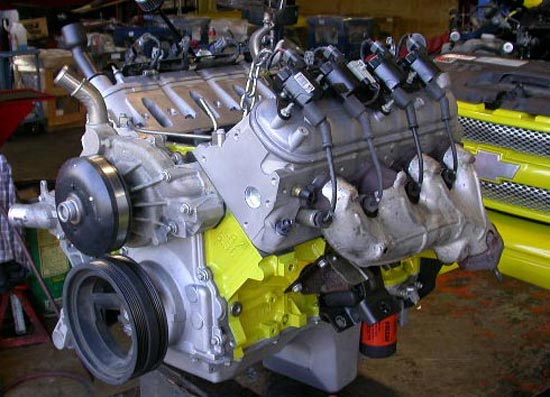
- 1997-2004 LS1 - 5.7 L V8
- 1999-2004 LS1 C4B - 5.7 L V8 - Callaway modified LS1
producing 300 kW (400 hp) used in
HSV sedans and coupes
- 2001-2004 LS6 - High-output LS1
- LR4 Vortec 4800 - 4.8 L
- L33/LM4/LM7/L59 Vortec 5300 - 5.3 L
- LQ4 Vortec 6000 - 6.0 L
- LQ9 Vortec HO 6000 - High-output 6.0 L
2005-present Generation 4 small-block pushrod V8 family:
- 2005-present L76 - 6.0 L
- 2005-present L98 - 6.0 L
- 2005-present LS2 - 6.0 L
- 2006-present LS4 - 5.3 L transverse V8
- 2006-present LS7 - 7.0 L
High-performance Gen IV engine
- 2008-present LS3 - 6.2 L
- LH6/LY5/LC9 Vortec 5300 - 5.3 L Vortec
- LY6/L76 Vortec 6000 - 6.0 L Vortec
- L92 Vortec 6200 - 6.2 L Vortec
Other GM V8 engines include the following:
- 1982-2000 Detroit Diesel V8 - 6.2/6.5 L Diesel
- Duramax Diesel V8 family:
- LG5 - 7.8 L Diesel
- LB7/LLY/LBZ/LMM - 6.6 L turbocharged Diesel
- 1992-present Premium V DOHC
- LD8/L37/LH2 Northstar - 4.6 L V8
- L47 Aurora - 4.0 L V8
- 2009- Light-Duty Diesel - DOHC compact Diesel V8[1]
GM V12 Engines:
Cadillac has produced just one V12 engine, in the 1930s. Since
then, the division has investigated a new V12 multiple times,
but has not yet brought one back into regular production.
- 1930-1937 Cadillac V12
- 1960s GMC "Twin Six" - 60degree V12 for commercial trucks
- 1963 Cadillac; all-aluminum, 500 CI V-12 engineering
program, 6 built, none sold.
- 1980s Cadillac Aluminum V12 - Never produced
- 2000s Cadillac Northstar V12 - Upcoming V12 variant
- 2007 High Feature V12 - rumored
GM V16 Engines
Cadillac:
- 1930-1937 Series 452
- 1938-1940 Series 90
- 2003 V-16 concept car
Chevrolet
small block Engines
- SB2
and SB2.2
- 262
- 265
- 267
- 283
- 302
- 305
- 307
- 327
- 350
- 400
- LG3
- LG4
- L69
- LE9
- LO3
- LO5
- LB9
- ZQ3
- L31
- L46
- LT-1
- L48
- L81
- L82
- L83
- L98
- LM1
|
 We
have a gas engine for your Chevrolet, Chevy, GMC, Cadillac,
Pontiac or GM car or truck. We offer quality remanufactured
4, 6 and 8 cylinder engines, including 4 cylinder, V6, V8 and
V10 engines as well as high performance small block Chevy motors.
We
have a gas engine for your Chevrolet, Chevy, GMC, Cadillac,
Pontiac or GM car or truck. We offer quality remanufactured
4, 6 and 8 cylinder engines, including 4 cylinder, V6, V8 and
V10 engines as well as high performance small block Chevy motors.